Every year, the sophistication of electronic products increases. Automotive control systems, medical devices, factory automation systems, IoT systems, EV charging system, telecommunication equipment, and consumer electronics heavily rely on effectively designed and properly manufactured electronic systems to function correctly.
This is where electronic system design and manufacturing come into play.
Electronic System Design and Manufacturing (ESDM) embraces a wide range of activities within the value chain of electronics products, ranging from designing electronic products and developing prototypes to PCB assembly, testing, system integration, and manufacturing. As per the Indian Ministry of Electronics and Information Technology, ESDM encompasses the whole value chain of various verticals in the electronics sector such as EMS, strategic electronics, industrial electronics, automotive electronics, telecommunications electronics, and medical electronics.
For an OEM, startup, or product company, delivering a PCB should be nothing but a piece of cake. The goal is to convert a technical idea into a usable and profitable electronic product.
This guide explains the process, stages involved, the role of the EMS and ODM partners, and key considerations for businesses before choosing an electronic manufacturer.
What Is Electronic System Design & Manufacturing?
In electronic system design & manufacturing, electronic products and systems are designed, developed, prototyped, produced and integrated.
This includes:
- Concept development of the product
- Hardware design of electronics
- PCB layout and design
- Firmware development
- Mechanical integration of the system
- PCB manufacturing
- PCB assembling
- Procurement of materials
- Prototype creation
- Testing
- Assembly
- Integration of systems
- Production
The exact activities depend on the manufacturer and its capabilities.
The manufacturer concentrates only on the product assembly and sourcing, while the ODM company can offer more services, including design and development of the product.
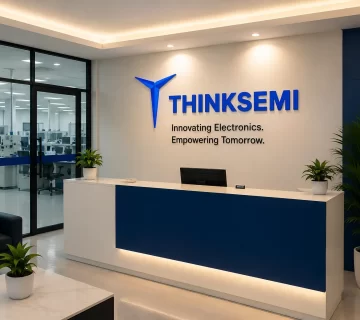
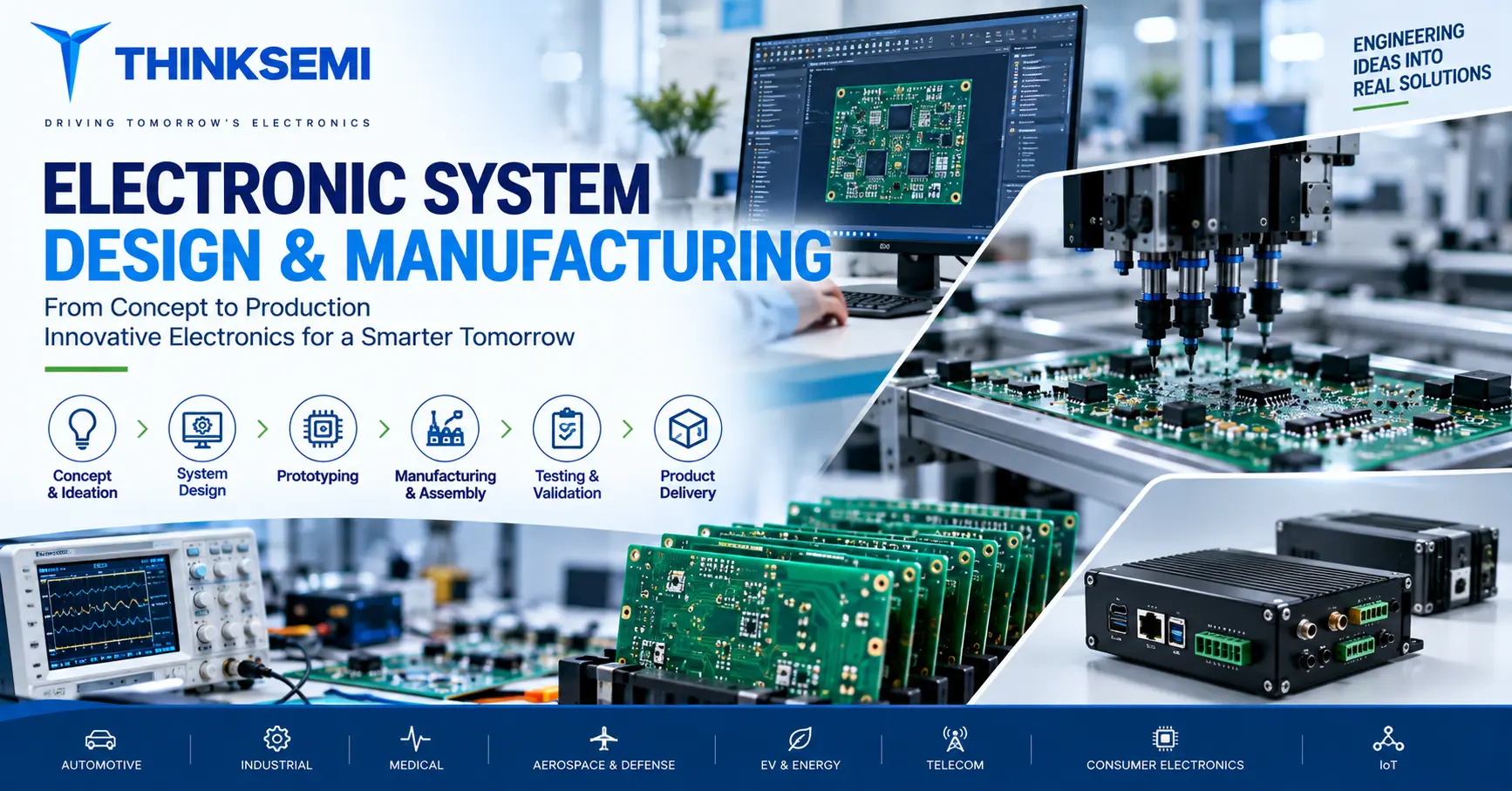
An example of this is ThinkSemi company, which claims to offer services from the beginning of the product lifecycle (ideation and prototyping) till its end (production and testing).
The importance of Electronic System Design
Great manufacturing cannot offset fundamentally bad design of the product.
The design choices made in the initial stages of the project influence the following:
- Reliability of the product
- Cost of manufacturing
- Availability of components
- Thermal characteristics
- Electrical characteristics
- Complexity of assembly
- Requirements for testing
- Lifecycle of the product
- Time to market
That is why designers and manufacturers should increasingly work together.
Design for manufacturing
Design for manufacturing (DFM) evaluates whether it is possible to produce a product successfully and reliably.
The DFM review can highlight any problems with:
- Placement of components
- Components that would be hard to find
- PCB clearance not being enough
- Thermal problems
- Problems with soldering
- Mechanical interference
- Testing issues
- Regulatory requirements
Identifying the above-mentioned problems during the design stage is often more effective than doing so when the product has already been manufactured.
The essential Procedures in Engineering & Producing Electronic Equipment
An electronic product goes through many steps in production that are connected with one another.
1. The idea and requirements of an electronic product
The beginning of the engineering process is the need for electronic products.
The engineering team has to determine the following:
– functions of the electronic device
– place of its usage
– other features such as
– energy consumption
– connection methods
– operating conditions
– the volume of production needed
– costs to be covered
– specifications that must be adhered to by all firms producing the electronic item
For example, in the case of an industrial processor, it must work all the time. In contrast, when talking about a consumer product for the Internet of Things, it must be small, require little energy, and be connected to the Internet without wires.
2. Electronics Hardware design
When the requirements are formed, engineers start developing the electronic structure.
The choice of components to be used is made, and they can be:
– microcontrollers
– microprocessors
– sensors
– integrated circuits used for managing electric potential
– memory
– means of communication
– devices that connect different circuits
– protective elements
The design team has to draw a schematic of the device and describe how the parts
3. PCB Design and Development
Physical PCB layout is derived from schematic diagrams.
There are different areas of focus in PCB design including:
– Components
– Circuit routing
– Power distribution
– Planes
– Stack-up
– Thermal management
– Connectors
– Size
Connections may at times require PCB designs to be multilayered.
Also, PCB design has to consider the effort needed to manufacture and test the product.
4. Prototype development
Companies do prototype their product before starting full-scale production.
Creating prototypes lets engineers check whether the design works as anticipated.
Conducting proper testing helps to identify issues related to:
- Circuit design
- Compatibility of circuit parts
- Fitment
- Temperature level
- Firmware
- Assembly problems
Suppliers offer rapid prototyping services to help both old and new businesses with the process of implementation.
PCB Assembly and Production
After confirming the design, production stages begin for PCB production and assembly.
PCB production results in the creation of the actual circuit board, whereas PCB assembly is responsible for the installation of electronics on that board.
SMT Assembly
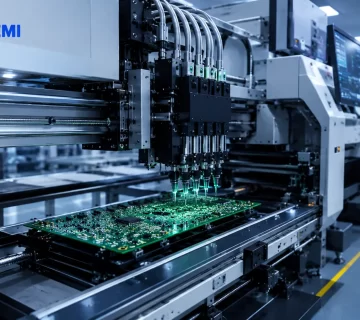
Surface Mount Technology (SMT) is widely used in electronics.
SMT production includes:
- Paste printing
- Paste inspection
- Component placement
- Reflow baking
- Optical inspection
- Functional testing
Through-Hole Assembly
Through holes make it possible to install some components directly into the PCB.
Through-hole technology can be advantageous where components must have specific strength of assembly requirements.
Modern manufacturing practices mix SMT processes with through-hole technology depending on the type of product.
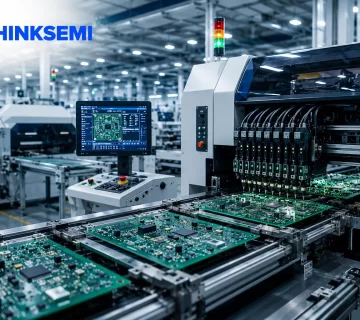
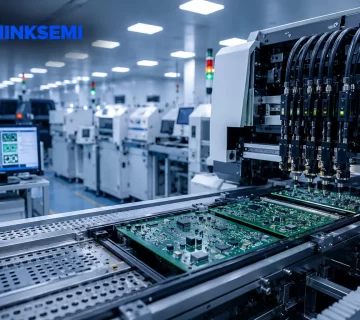
ThinkSemi is known to practice SMT and THT assembly, AOI, ICT and functional testing when manufacturing features.
Component Sourcing and Supply Chain Management
Even the most sophisticated PCB design may not be produced on time if necessary components are not available.
Thus, component sourcing is an important aspect of electronic systems design.
Manufacturing companies may assist in:
- Bill of Materials preparation
- Supplier selection
- Acquisition of components
- Researching alternatives
- Inventory organization
- Lead-time organization
- Supply continuity
Why Component Selection Matters
Engineers should not limit their considerations to component prices;
they need to analyze other factors:
- Availability
- Status in a product life cycle
- Approved suppliers
- Lead time
- Electrical properties
- Quality
- Long-term availability
ThinkSemi states that it provides component sourcing services with the help of the existing supplier network while paying attention to various aspects of the process.
Testing and Quality Control
Testing is an essential procedure in the electronics manufacturing industry.
A PCB may appear flawless on the surface, but there might still exist an electrical or functional defect within it.
Testing may involve the following processes depending on the product:
Automated Optical Inspection.
Automated Optical Inspection (AOI) is the method that uses camera images for the detection of defects in the assembly, such as incorrect assembly of components and soldering defects.
Solder Paste Inspection.
3D Solder Paste Inspection (SPI) is conducted to assess the solder paste before the parts installation process.
In-Circuit Testing.
In-circuit Testing is used to analyse electrical characteristics and circuit connections.
Functional Testing.
Functional Testing works to make sure that the finished assembly fulfils the expected requirements of operation.
Environmental and Reliability Testing.
Additional tests may be performed depending on the application. They may include testing for:
- Temperature
- Vibration
- Humidity
- Electrical stress
- Mechanical conditions
- Long-term reliability
A right testing strategy should be determined based on the product’s technical and regulatory requirements.
Box Build Assembly Together with System Integration
Designing and manufacturing electronic systems does not always end with assembled PCB’s. Many Original Equipment Manufacturers require a fully finished electronic product rather than merely an assembled PCB. Box-build assembly and system integration come into play.
Box build can contain:
– PCB assemblies
– Wiring harnesses
– Cables
– Mechanical components
– Enclosures
– Displays
– Power supplies
– Connectors
– Firmware
– Labels and Packaging
The final product then goes through the final inspection and testing before being shipped to customers.
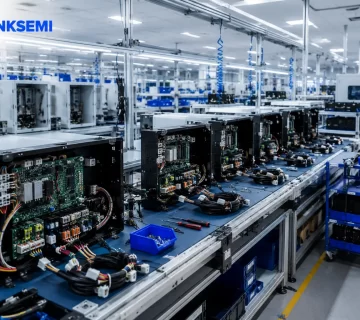
According to ThinkSemi, box build service consists of integration of PCB’s with ridged harnesses, mechanical components, enclosures and electronic systems into the ready product.
Industries Using Electronic System Design & Manufacturing
Electronic system design and manufacturing supports a wide range of industries.
| Industry | Example Applications |
| Automotive | Control units, telematics, EV electronics |
| Industrial | Automation controllers, sensors, control systems |
| Medical | Monitoring and diagnostic equipment |
| Aerospace | Avionics and electronic control systems |
| Defense | Communication and electronic systems |
| EV | Battery systems and charging electronics |
| Telecom | Networking and communication equipment |
| IoT | Connected sensors and smart devices |
| Consumer Electronics | Smart devices and appliances |
| Power Electronics | Power management and conversion systems |
ThinkSemi currently recognises industries such as automotive, medical, charging stations, telematics, defence, electric vehicles, telecoms, and energy as the industries it covers.
Working with an end-to-end manufacturing partner has many advantages.
Relying on many suppliers for design, PCB assembly, testing and final integration increases coordination demands.
With an end-to-end manufacturing partner, multiple stages can be included in one process.
1. Fewer Changes of Supplier
Design, sourcing, manufacturing and testing can be done simultaneously.
2. Quicker Development
Engineers can detect problems in the production process sooner.
3. More Efficient Production Management
BOMs, production schedules, assembly and testing can be handled by one partner.
4. Simpler Production Scaling
A verified prototype can swiftly move from low-volume production to large-scale manufacturing.
5. Better Communication
Coordination of the project is more effective if there is one point of contact.
Criteria for Choosing an Electronic System Design & Manufacturing Partner.
Different electronics manufacturers may provide different levels of capabilities.
Before choosing an EMS or electronics manufacturer, ask yourself:
Engineering Skills
Find out whether they can handle the following:
- Hardware design
- PCB development
- Firmware
- Mechanical integration
- DFM
- Prototyping
Manufacturing Skills
Find out about the following items:
- SMT lines
- THT assembly
- PCB prototyping
- PCB fabrication
- Box build
- Wiring harnesses
- System integration
Testing Skills
Ask about the following:
- AOI
- SPI
- ICT
- Functional testing
- X-ray testing
- Reliability testing
Quality Systems
Make sure the relevant certifications and their scopes are met.
For instance, ThinkSemi claims the ISO 9001:2015 and IATF 16949 certifications and talks about their quality assurance in the provided descriptions on their website.
Production Capacity
The partner you choose should be able to meet your production volumes and have an opportunity to grow.
The growth of India’s electronics manufacturing economy is related to production, assembly, components, and system manufacturing.
As per information published by the Government in September 2026, India has seen the production of electronics increase from ₹1.9 lakh crore in 2014-15 to ₹13.11 lakh crore in 2025-26 and electronics exports have increased to ₹4.24 lakh crore in the same period.
In the outlined policy framework of the country, Electronics System Design and Manufacturing is recognized as one of the main developments in order to get a competitive local electronics value chain.
This means that OEMs and product companies will have favorable conditions to develop and produce more electronics in India and build local engineering and supply chain capabilities.
One of the places where this burgeoning ecosystem is being developed today is Chennai, where the factory of ThinkSemi is located in SIPCOT IT Park, Siruseri, Chennai. The company states that its manufacturing facility is ESD protected and supplied with automated manufacturing machines.
Common Mistakes to Avoid
Not Validating the Prototype Prior to Production
Prototype serves to identify any problems with manufacturing and technology before the process is scaled up.
Disregarding Availability of Components
A component can be suitable from the technological viewpoint but not be a viable option in terms of its availability or long lead time.
Designing without the Input of Manufacturing
Getting other engineers involved early on in the process can reduce production problems that may occur while the design is still in progress.
Making Testing an Afterthought
Consider testing from the very beginning so that it is not done after production.
Choosing a Partner Solely with Consideration of Price
The cheapest quotation does not mean that the manufacturing costs will be minimal. Pay attention to the quality, engineering support, testing, lead times, sourcing, and scalability.
Frequently Asked Questions
What is electronic system design and manufacturing?
Electronic system design and manufacturing is the process of designing, developing, prototyping, manufacturing, testing and integrating electronic products and systems.
What is the difference between EMS and ESDM?
EMS, or Electronic Manufacturing Services, generally focuses on manufacturing-related activities such as PCB assembly, sourcing, testing and production. ESDM is broader and encompasses the wider electronic system design and manufacturing value chain.
Why is prototyping important in electronics manufacturing?
Prototyping allows engineering teams to validate the design, identify technical problems and test manufacturability before moving into larger production volumes.
What industries use electronic system design and manufacturing?
Automotive, EV, medical, industrial automation, telecom, aerospace, defense, IoT, consumer electronics and power electronics are among the industries that depend on electronic system design and manufacturing.
What should I look for in an electronics manufacturing partner?
Evaluate engineering capabilities, prototyping, PCB assembly, component sourcing, testing, quality systems, production capacity, system integration and the ability to scale production.
Final Thoughts
Designing and manufacturing electronic systems combines various processes such as engineering, prototyping, PCB manufacturing, sourcing materials, assembling the components in a certain order, testing and system streamlining.
The best strategy for successful electronic system manufacturing is to incorporate the necessity of manufacturing from day one instead of doing it after the design is completed. DFM review, prototype approval, component logistics, and tests will help minimize the manufacturing risks.
If one develops products for the automotive, industrial, medical, EV, IoT, telecommunications, aerospace or defense industry, one can find a reliable EMS or ODM partner with engineering and manufacturing expertise to handle their project.
ThinkSemi Infotech offers electronic products manufacturing and ODM services such as product engineering, prototyping, PCB assembly, sourcing, testing and box build manufacturing in Chennai.
Once you plan your new electronic product, it is essential to define product parameters, PCB design, prototype, materials, and production volume, and then look for a partner to assist in the production process.