
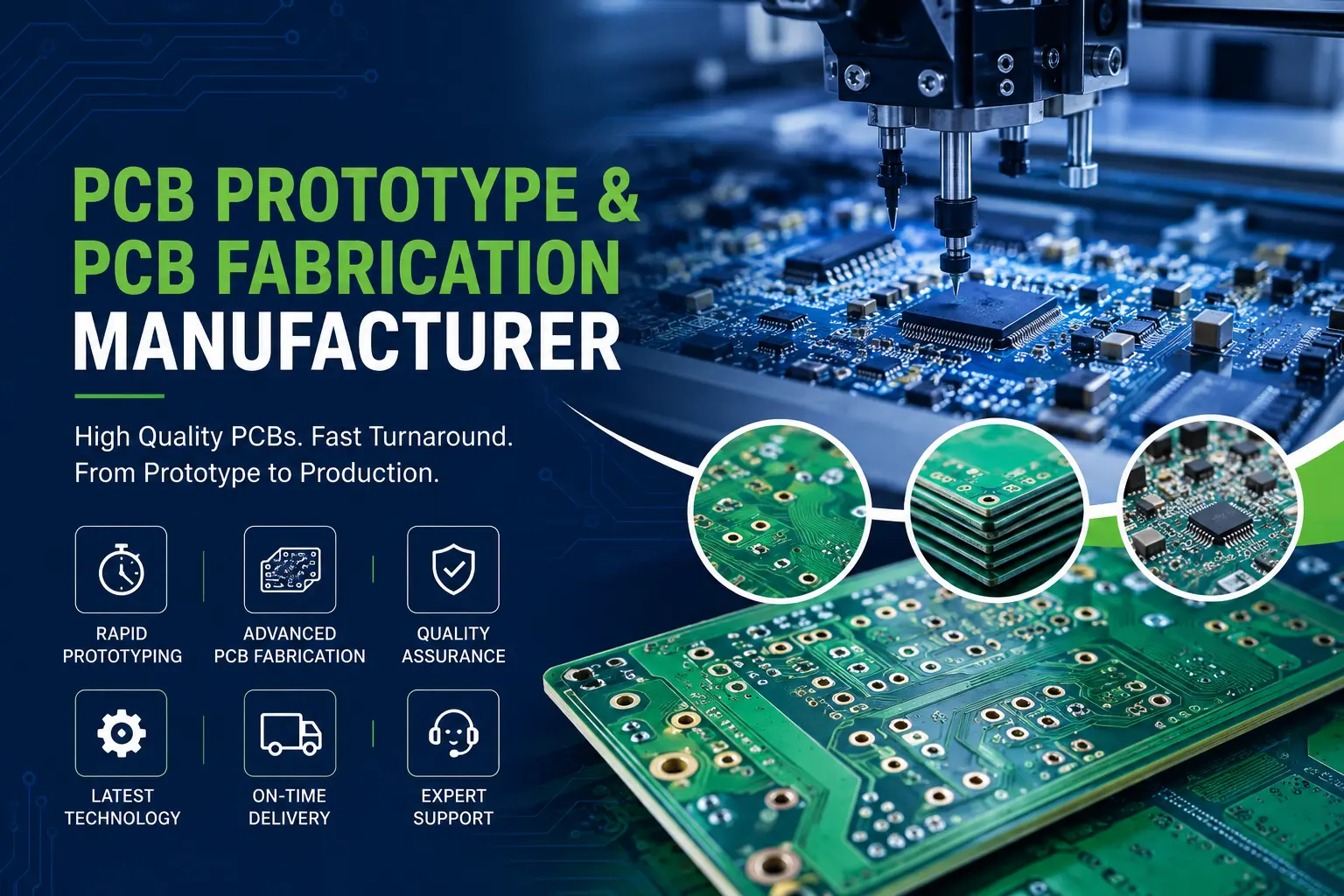
Reliable PCBs-the building blocks for your electronic products-are essential to bring your ideas into existence. Whether designing an IoT device, an industrial controller, a medical device, automotive electronics, or an aerospace system, choosing a capable PCB Prototype & PCB Fabrication Manufacturer is one of the most critical decisions made during the product development process.
This dedicated partner does more than just make circuit boards: it validates your design, cuts down development expenses, increases the quality of your product, and expedites market entry. From fast-paced prototyping to large-volume manufacturing-every step demands precision, modern manufacturing methods, and stringent quality control protocols.
This guide will give you an understanding of PCB prototyping and fabrication- how and why they are critical, the process of manufacturing, relevant quality standards, and how to select the ideal PCB fabrication provider to achieve project success.
What is a PCB Prototype & PCB Fabrication Manufacturer?
A PCB Prototype & PCB Fabrication Manufacturer specialises in designing and producing PCBs that will be used for development, testing, and subsequent mass production of an electronic product. Their primary role is to take your PCB design files and create them into high-quality circuit boards that meet all electrical, mechanical, and performance requirements.
The range of services provided by these manufacturers usually includes:
- PCB prototyping
- Single-sided and Double-sided PCB fabrication
- Manufacturing of multilayer PCBs
- HDI (High-Density Interconnect) PCBs
- Designing flexible and rigid-flex PCBs
- Producing Metal Core PCBs (MCPCB)
- PCB assembly (SMT & Through-Hole)
- Performing functional testing and inspections
Featured Snippet Answer
A PCB Prototype & PCB Fabrication Manufacturer works by transforming your electronic product design into a functional printed circuit board, offering prototype development, fabrication, testing, and full production services for a variety of industries.
PCB Prototyping: An Indispensable Step Before Mass Production
PCB prototyping provides engineers with the capability to validate a circuit design prior to committing to expensive full-scale manufacturing. It has the power to identify issues early in the design phase, thus decreasing development costs, preventing production delays, and improving the product’s overall reliability.
PCB Prototyping’s Advantages:
- Detects design faults before manufacturing.
- Minimises costly redesign measures down the line.
- Speeds up the product development life-cycle.
- Lowers manufacturing expenditures.
- Validates electrical and mechanical performance.
- Enhances product robustness.
For startups and established manufacturing firms alike, rapid PCB prototyping can dramatically shorten time-to-market.
The PCB Fabrication Process Demystified
The process of PCB fabrication translates a digital circuit design into a physical printed circuit board. It’s achieved by a series of tightly controlled manufacturing stages:
1. Design Verification (DFM Review):
Before production, engineers conduct a thorough review of design files to ensure they adhere to manufacturing standards. These typically encompass Gerber, drill, and BOM files, along with stack-up details and fabrication diagrams. A Design for Manufacturability (DFM) review is vital for minimising production challenges and maximising yield.
2. Material Selection:
The foundation of every PCB is its substrate material, whose electrical properties will be critical to the PCB’s performance. Some of the widely used materials are FR-4, High TG FR-4, Rogers laminates, Aluminum Core, Polyimide, and ceramic substrates. The choice depends on factors like operating temperature, electrical specifications, and application-specific requirements.
3. Imaging and Etching:
Photoimaging techniques are employed to transfer the circuit pattern onto the copper-clad laminate. Subsequently, chemical etching removes the redundant copper to create the exact conductive traces as dictated by the PCB design.
4. Drilling and Plating:
Precision drilling creates holes for component placement, through-holes (vias), and blind/buried vias to connect internal layers. These holes are then copper-plated to establish electrical continuity between layers.
5. Solder Mask and Surface Finish:
A solder mask protects the conductive copper traces from unintentional solder bridges during assembly. Commonly used surface finishes include ENIG, HASL, OSP, Immersion Silver, and Immersion Tin, chosen to improve solderability and prolong the PCB’s functional lifespan.
PCB Types You Can Count on:
A professional PCB Prototype & PCB Fabrication Manufacturer can produce many kinds of PCBs for diverse applications:
| PCB Type | Common Applications |
| Single-Sided PCB | Consumer electronics, LED lighting |
| Double-Sided PCB | Power supplies, industrial controls |
| Multilayer PCB | Networking, computers, telecom equipment |
| HDI PCB | Smartphones, medical devices, wearables |
| Flexible PCB | Cameras, automotive electronics, aerospace |
| Rigid-Flex PCB | Military, medical, aerospace applications |
| Metal Core PCB | High-power LED systems, power electronics |
The appropriate type of PCB will be determined by your product’s complexity, the environment in which it will operate, and its expected performance.
High-Quality PCB Fabrication Manufacturer
In many sectors of the electronics industry, the presence of high-quality PCB fabrication provides support.
The Automotive Sector
Automotive designs necessitate reliable PCBs to facilitate the working of:
- Engine controls
- Infotainment
- ADAS
- The control systems of electrical automobiles
Medical Devices
These utilize advanced PCBs to develop:
- Diagnostic equipment
- Patient monitors
- Imaging machines
- Hand-held devices
The Industrial Automation Sector
High-quality PCBs are critical for the proper functioning of:
- PLCs
- Robotics
- Process automation controllers
- Power supplies
The Consumer Electronics Sector
Its uses vary from:
- smartphones
- Laptops
- To smart home products
- Gaming systems
The Aerospace and Defence sector
This sector uses many ML PCBs with robust quality, where every material is traceable, and all parameters meet strict quality standards.
Quality Standards at PCB Fabrication Manufacturers
Every reputable PCB manufacturer will implement strict quality checks along their manufacturing processes. Some of the most typical inspection practices include;
Automated optical inspection (AOI)
Used to detect many aspects: whether the components are correctly placed and present, whether there are any visible solder defects, and if the component positioning is correct.
X-ray Testing
Often used to test a solder joint that may be hidden, particularly in MLBs or BGAs.
Electrical Testing
To ascertain the continuity and presence of short circuits between elements in your board.
Functional Testing
To guarantee the circuit board performs as expected during a working process.
These are the many quality requirements adhered to by PCB Fabrication Manufacturers serving the higher reliability industries:
- IPC-A-600
- IPC-A-610
- IPC J-STD-001
- ISO 9001
- AS9100
- ISO 13485
Selecting a High-Quality PCB Prototype & PCB Fabrication Manufacturer
Your relationship with your manufacturing partner will directly impact the quality of your product, the timely delivery, and overall product reliability. When determining if a manufacturer is a good fit, the following criteria should be carefully weighed:
| Evaluation Criteria | Importance |
| Manufacturing Experience | Ensures consistent production quality |
| Engineering Support | Helps optimize PCB designs |
| DFM Capability | Reduces manufacturing defects |
| Quality Certifications | Demonstrates compliance with industry standards |
| Testing Facilities | Improves product reliability |
| Production Capacity | Supports both prototypes and large-scale manufacturing |
| Technical Support | Assists throughout the product lifecycle |
What Questions to Pose to an Electrical Design Manufacturer
To effectively find an excellent manufacturing partner:
- Do you cater to rapid PCB prototyping?
- Are you able to do double and MLBs and also complex, dense parts such as HDI PCBs?
- Do you currently have relevant accreditations or quality standards?
- Do you have your own in-house testing methods? If so, what are they?
- Can you offer an assembly service?
- What are your limitations for prototypes, low volume or mass production?
The Common Mistakes of PCB Prototyping
By learning from typical failures, you can eliminate extra time and cost expenditures in your process.
- Failure in sending entire Gerber sets.
- The ignoring of DFM requirements.
- Selecting an unsuitable material from the range available.
- Jumping straight to mass production without prototype confirmation.
- Overlooking testing requirements.
- Selecting suppliers based on cost alone.
Working in partnership with a design engineer within your selected PCB manufacturer is imperative.
Successful PCB Fabrication Project Practices
For efficient manufacture, the following procedures should be adhered to:
- Review all supplied documents before manufacturing.
- Select appropriate materials according to the product working environment.
- Test all prototypes carefully before progressing to mass production.
- Follow all IPC guidelines for PCB construction.
- Plan with future expansion in mind.
Establish a working partnership with a high-quality PCB manufacturing business.
Conclusion
Choosing the best PCB Prototype and PCB Fabrication Manufacturer is critical for you to assemble dependable and performant electronic products. Every part of the journey, including fast prototyping, high-precision fabrication, quality control, and scalable production, is of value.
A quality PCB manufacturing partner offers more than quality PCBs alone. It also contributes engineering support, comprehensive quality checks, and reliable assistance for your product’s entire lifespan. For you to either bring your product ideas from initial proofs of concept into serial manufacturing or ensure your current production is of top-quality standards, partner up with a dependable PCB fabrication business that fits your needs.
Begin your next PCB endeavour by working with a well-rounded PCB Prototype and PCB Fabrication Manufacturer that can provide a seamless fabrication, assembly, and testing experience, as well as deliver you high-quality, reliable electronics at every step of the way.
