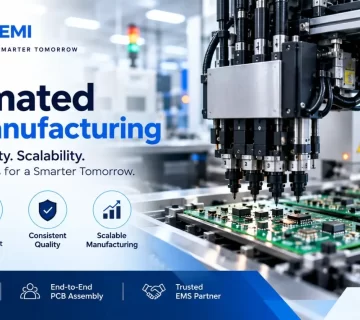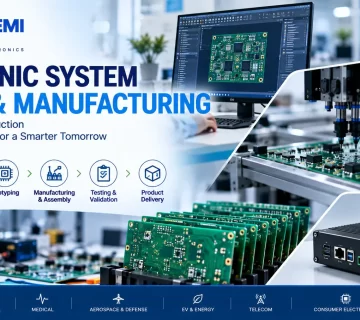
Every modern gadget runs on a printed circuit board (PCB). If you build medical devices, car controllers, factory automation, or flight gear, you need solid PCB assembly and manufacturing.
As tech shrinks and speeds up, precision matters more than ever. A tiny defect on a board easily ruins the whole system or forces expensive repairs. Reliable boards require specific manufacturing steps, strict quality checks, and smart design choices. Here is how the process works and why military and aerospace projects demand absolute perfection. If you are looking for a reliable printed circuit board company, understanding these basics is crucial.
What is PCB assembly and manufacturing?
PCB assembly and manufacturing is the process of building a bare board and soldering components onto it to make a working circuit.
The entire build splits into 2 main stages:
| Process | Description |
| PCB manufacturing | Fabricating the bare board, including layers, copper traces, drilling, and surface finishes. |
| PCB assembly | Placing and soldering electronic components onto the finished bare board. |
These steps turn your digital design files into physical, working hardware.
Short answer: PCB assembly and manufacturing means fabricating a raw circuit board and soldering parts onto it to build a working electronic device.
Understanding the PCB manufacturing process
Manufacturing starts when you turn a digital schematic into a physical board. Expert OEM PCB manufacturing services manage this transition seamlessly.
1. PCB design and engineering
Engineers design the board layout using specialized design software. They generate a standard package of files:
- Gerber files
- Drill files
- Bill of Materials (BOM)
- Assembly drawings
- Pick-and-place files
A clean design prevents factory floor errors and keeps your hardware running long-term.
2. Material selection
Most boards use standard FR-4, but you can choose other materials if your project has unique needs.
Common materials:
- FR-4
- High-frequency laminates
- Aluminum-core boards
- Polyimide flex circuits
- Ceramic substrates
The material you choose directly dictates:
- Heat management
- Electrical performance
- Physical strength
- Long-term durability
3. Layer formation and imaging
Workers coat copper-clad sheets with light-sensitive photoresist and expose them to UV light to trace the circuit. This step shapes your signal pathways, power routing, and ground planes. Sharp imaging keeps these copper traces thin and perfectly spaced.
4. Etching and drilling
A chemical bath eats away the extra copper to reveal your traces. Next, high-speed machines drill holes through the board:
- Through holes
- Blind vias
- Buried vias
- Mounting holes
For highly packed designs, factories swap mechanical drill bits for lasers to shoot tiny microvias.
5. Surface finishing
Raw copper rusts quickly, so factories coat the exposed pads to help the solder stick.
Common finishes:
- ENIG (Electroless Nickel Immersion Gold)
- HASL (Hot Air Solder Leveling)
- Immersion Silver
- Immersion Tin
- OSP (Organic Solderability Preservative)
Your choice depends on your budget and how rugged the board needs to be.
The PCB assembly process explained
Once the bare board is finished, it moves over to the assembly line to begin the printed circuit boards assembly phase.
Solder paste application
The assembly line starts by squeegeeing solder paste onto the metal pads through a thin steel stencil. You have to get this paste volume exactly right. Too much or too little solder ruins the joint.
Component placement
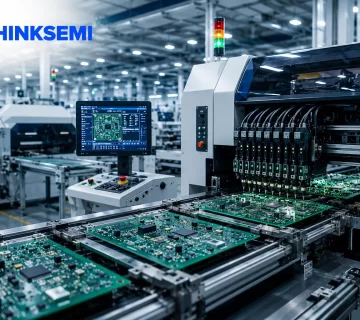
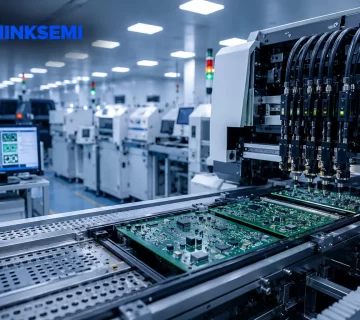
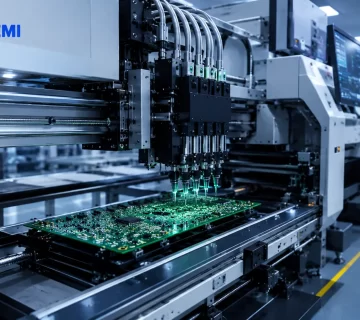
Robotic pick-and-place arms drop components onto the wet paste at high speeds. This is often referred to as SMT assembly, where surface-mount technology is utilized.
These machines can place:
- Resistors
- Capacitors
- ICs
- Connectors
- Microprocessors
- BGA packages
In fact, fast lines routinely mount tens of thousands of parts every hour.
Reflow soldering
The board then rides a conveyor belt through a multi-zone reflow oven. The intense heat melts the paste, which solidifies into a solid joint once cooled. The oven carefully manages 4 distinct temperature zones:
- Preheat
- Soak
- Reflow
- Cooling
Through-hole assembly
Parts that take a beating need extra strength, so workers push their pins directly through the drilled holes. This includes:
- Transformers
- Large connectors
- Power devices
- Aerospace-grade components
Instead of reflow ovens, these are secured via automated wave or selective soldering machines, or hand soldering with manual irons.
Quality control in PCB assembly and manufacturing
You can’t afford sloppy work in electronics assembly. A single cold joint or bridged pin can kill a device or make it fail in the field.
Common inspection methods
- Automated Optical Inspection (AOI): AOI machines scan every board with high-resolution cameras and pattern-matching software. They quickly flag missing components, reversed polarities, solder bridges, and misaligned parts.
- X-ray inspection: You can’t see beneath some parts with a standard camera. We use X-rays to inspect hidden joints under BGA chips, QFN packages, and dense multilayer layouts.
- In-circuit testing (ICT): ICT uses a bed-of-nails fixture to press against test points on the board. It checks component values, trace continuity, unwanted shorts, and open circuits.
- Functional testing: This is the final exam. Technicians boot up the board and run it through simulated real-world tasks to make sure it performs exactly as designed.
Industry standards
Any factory worth its salt builds to recognized global standards set by organizations like IPC. Look for shops certified in:
PCB assembly and manufacturing for defense and aerospace
Building boards for military jets and rocket boosters is a different league compared to consumer toys. These boards operate in brutal environments where a single glitch can be catastrophic.
Key requirements
- High reliability: These circuits must run perfectly for decades without a single hiccup. You find them in radar systems, communication equipment, flight control systems, navigation systems, missile guidance systems, and satellite electronics.
- Environmental resistance: The finished assemblies have to survive punishing physical conditions. They must resist thermal swings, heavy vibration, G-forces and shock, high humidity, corrosion, and electromagnetic interference.
- Traceability: You have to track every silicon wafer, resistor, and solder roll back to its original batch. This paper trail is required for regulatory audits, quality control guarantees, root-cause failure analysis, and lifetime product tracking.
- Advanced testing: Before shipping, these boards go through rigorous physical testing. Common tests include thermal cycling (oven to freezer), shake-table vibration testing, burn-in testing, environmental stress screening, and long-term reliability testing.
Why specialized manufacturing matters
Aerospace and defense systems require zero-tolerance manufacturing. Because lives are on the line, specialized factories providing premium PCB assembly services spend heavily on tight process controls, high-end inspection systems, certified assembly engineers, and cleanroom environments.
Where PCB assembly and manufacturing gets tricky
Even the most seasoned assembly shops run into problems. Partnering with a top electronic manufacturing service in India can help mitigate these risks.
- Design for manufacturability issues: Bad board layouts cause massive headaches on the factory floor. They frequently lead to traces squeezed too close together, solder bridging across pins, component collisions, and alignment errors. (Pro tip: Always run a complete Design for Manufacturability (DFM) review before you pay for a production run.)
- Component availability: A single missing resistor can stall your entire production run for months. To keep your line moving, you should maintain an approved vendor list, design in alternative parts for hard-to-find chips, order critical components months in advance, and plan production forecasts early.
- Thermal management problems: High-power circuits get incredibly hot, and heat kills electronics. Designers solve this using heavy thermal vias, mounted heat sinks, metal-core board substrates, and smart component spacing.
- Insufficient testing: If you skip testing to save a few bucks, you’ll pay for it later when products die in the field. A thorough test plan catches assembly defects before your customers do.
How to choose the right PCB assembly and manufacturing partner
The factory you choose directly dictates your build quality, unit costs, launch timing, and customer satisfaction. Whether you need full box build assembly or just bare boards, look at these factors when shopping around:
| Evaluation criteria | Why it matters |
| Industry experience | They have probably seen your specific layout challenges before and know how to avoid errors. |
| Certifications | Proves they actually follow strict quality control and safety guidelines. |
| Engineering support | They’ll spot layout mistakes before committing your design to copper. |
| Testing capabilities | Keeps you from shipping dead hardware to your customers. |
| Production capacity | Ensures they can scale up production when your sales take off. |
| Supply chain management | Helps them hunt down hard-to-find silicon when components run scarce. |
If you are specifically looking for local partners, exploring the electronics manufacturing companies in Chennai is a great starting point for finding top-tier PCB assembly in Chennai. You can even map out our manufacturing facility to see where the magic happens.
Best practices for successful PCB projects
A few smart moves can save you thousands of dollars and weeks of manufacturing delays.
- Plan early: Share your rough schematics with your factory engineers long before you finish the layout.
- Pick stable components: Don’t use exotic, single-source chips that might go out of stock next week.
- Design for the environment: Figure out if your board will live inside a hot engine bay or a vibrating machine before choosing substrates.
- Test everything: Use both optical scans and electrical tests so bad joints don’t sneak through.
- Keep deep records: File away every layout revision, BOM update, and test report so you can troubleshoot future batches.
Taking these extra steps drops your scrap rate and keeps your production on track.
Frequently asked questions (FAQs)
While both fall under the umbrella of PCB assembly and manufacturing, manufacturing builds the bare green board from copper, fibreglass, and resin. Assembly is the step where machines solder the actual chips, resistors, and connectors onto the finished board.
Simple prototype runs might take only 3 to 5 days. Large, complex production orders usually take anywhere from 3 to 6 weeks, depending on board complexity and component lead times.
Testing catches bad solder joints, dead components, and layout bugs before you ship the hardware. It’s the only way to make sure you aren’t sending expensive paperweights to your customers.
You’ll find these services behind almost every modern sector, including cars, medical devices, factory robotics, telecommunications, consumer gadgets, defense systems, and space gear.
These projects require specialized certifications like AS9100. The factories must use rugged materials, run severe environmental tests, and maintain an absolute paper trail for every single component on the board.
Conclusion
Your circuit board is the physical foundation of your entire product. If you cut corners on testing or pick a low-end assembly shop, your hardware will pay the price. To ensure the highest quality for your next project, rely on experts like Think Semi Infotech for end-to-end solutions.
So, don’t treat manufacturing like an afterthought. When you work closely with your assembly team, choose stable parts, and run proper tests, you build hardware that stands up to the real world.